


Dentist in Dubai Blog
TMJ Pain, Jaw Position and Sleep: What Is the Connection?
14
Oct
Oct
Quick answer
TMJ pain, jaw position, snoring and obstructive sleep apnea can overlap, but they are not the same condition and one should not be used as a shortcut to diagnose the other. Temporomandibular disorders (TMDs) affect the jaw joints, chewing muscles and related structures. Obstructive sleep apnea is a sleep-related breathing disorder involving repeated upper-airway narrowing or closure during sleep.
Jaw position is relevant because moving the lower jaw forward can alter upper-airway mechanics. That principle is used in mandibular advancement devices for selected adults. However, a dental exam cannot diagnose sleep apnea from jaw position or snoring alone, and an oral appliance should not be treated like a generic night guard.
In Dubai, Dubai Health’s Sleep Medicine service evaluates sleep disorders including sleep apnea. Dental sleep medicine can then contribute by assessing the teeth, bite, jaw joints, oral structures and suitability for custom oral appliance therapy.
TMJ, TMD and sleep apnea: what each term means
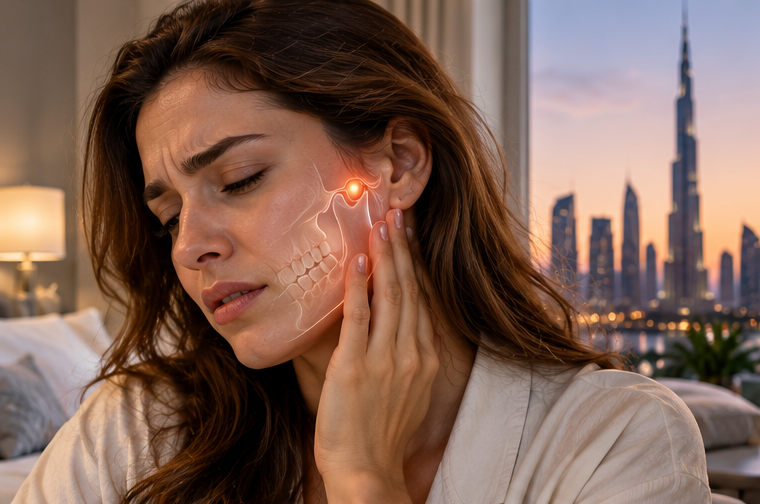
The TMJs are the two jaw joints located just in front of the ears. TMD is the broader term for disorders involving those joints, the chewing muscles or both. Symptoms can include jaw pain, stiffness, limited opening, locking, painful clicking, facial pain and changes in how the bite feels.
The National Institute of Dental and Craniofacial Research TMD overview notes that TMDs are a group of more than 30 conditions and recommends conservative, reversible approaches before treatments that permanently alter the jaw, teeth or bite.
Obstructive sleep apnea follows a different pathway. Loud snoring, gasping, witnessed breathing pauses, morning headaches and excessive daytime sleepiness can suggest a problem, but objective sleep testing may be required to confirm the diagnosis and severity.
How jaw position can influence the airway
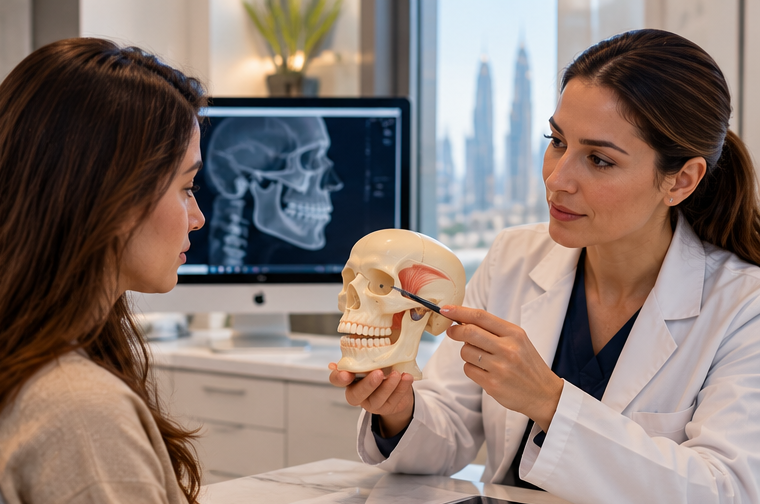
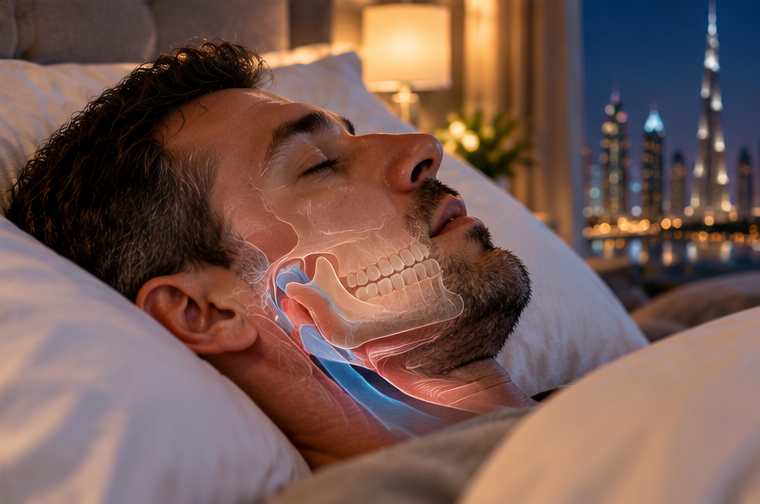
The lower jaw, tongue and surrounding soft tissues are mechanically related. In selected patients, moving the mandible forward can increase the space available in the upper airway and reduce its tendency to collapse during sleep. This is why custom mandibular advancement devices can be used for appropriate adults with primary snoring or obstructive sleep apnea.
But the airway is influenced by more than jaw position. Nasal resistance, sleep stage, body position, weight, craniofacial anatomy, neuromuscular control and medical factors can all matter. The safest approach is therefore to establish the sleep diagnosis first and then decide whether dental therapy is appropriate.
Dr. Amini’s Snoring and Sleep Apnea Dubai service focuses on the dental-sleep-medicine component of this pathway and explains her role in oral appliance therapy and multidisciplinary care.
Why jaw pain and sleep problems may occur together
Jaw pain and disrupted sleep can coexist for several reasons. A patient may clench or grind, develop muscle fatigue, have an established TMD, or experience increased pain sensitivity when sleep quality is poor. Some patients also notice jaw discomfort when adapting to an appliance that changes mandibular position.
Symptoms worth discussing include:
Jaw pain or tenderness on waking
Pain near the ears or temples
Jaw stiffness, locking or reduced opening
Painful clicking, popping or grating
Morning headaches
Tired chewing muscles
Teeth grinding or clenching
Worn, chipped or shortened teeth
Loud or persistent snoring
Witnessed breathing pauses, gasping or choking
Unrefreshing sleep or excessive daytime sleepiness
These symptoms do not all point to one diagnosis. The important step is to separate what is happening in the jaw from what is happening during sleep, then identify where the two problems interact.
How a proper assessment works in Dubai
A consultation normally starts with a detailed history. You may be asked when the jaw pain began, whether it is worse in the morning, whether the joint locks or clicks, whether you grind or clench, and whether you have snoring, gasping, morning headaches, concentration problems or daytime sleepiness.
The dental examination may include the teeth, gums, bite, existing restorations, jaw movement, joint tenderness, muscle tenderness, tooth wear, tooth mobility and the oral structures needed to support an appliance. If there is no confirmed sleep-apnea diagnosis, the dental findings can support screening and referral but do not replace a medical sleep assessment.
If tooth wear is substantial, Dr. Amini’s Full Mouth Reconstruction Dubai page explains how worn dentition can be assessed and restored while preserving healthy tooth structure where possible.
Night guard vs. mandibular advancement device
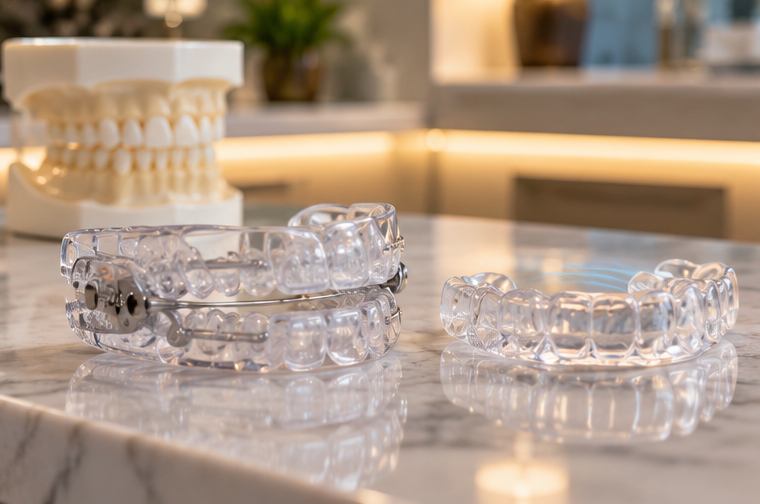
A night guard and a mandibular advancement device may both be worn during sleep, but they are designed for different clinical purposes. A conventional night guard generally protects teeth or redistributes bite forces. A mandibular advancement device deliberately positions the lower jaw forward to influence the airway.
That difference is crucial. A protective splint can help manage the consequences of grinding, but it does not prove whether a patient has sleep apnea and it is not automatically a treatment for upper-airway obstruction. Similarly, a sleep-apnea appliance should be custom-fitted and monitored rather than purchased as an off-the-shelf anti-snoring mouthpiece.
The American Academy of Dental Sleep Medicine’s current standards outline screening, comprehensive examination, appliance selection, calibration, side-effect management and long-term follow-up for oral appliance therapy.
Can oral appliance therapy affect the TMJs?
Yes. Because the device holds the lower jaw in a different position for several hours, some patients experience temporary morning jaw soreness, muscle tenderness, tooth discomfort or changes in how the bite feels. Longer-term changes in tooth position or occlusion can also occur.
For a patient with pre-existing jaw symptoms, this makes baseline documentation important. The clinician should understand the starting joint and muscle condition, record the bite and monitor symptoms as the appliance is adjusted. If symptoms become problematic, advancement may need to be modified or the treatment plan reconsidered.
AADSM’s side-effect management guidance specifically addresses temporomandibular-joint and masticatory-muscle effects associated with oral appliance therapy.
What treatment options might be discussed?
The correct treatment depends on the diagnosis rather than on a single symptom. TMD is often approached conservatively, while obstructive sleep apnea may be treated with positive-airway-pressure therapy, oral appliance therapy or other strategies according to severity and medical assessment.
Depending on the findings, options can include:
Conservative TMD self-care and reduction of aggravating jaw habits
Medication or physiotherapy when clinically appropriate
Management of clenching and grinding
CPAP or other positive-airway-pressure therapy
A custom mandibular advancement device for selected adults
Positional or lifestyle strategies recommended by the sleep clinician
Management of nasal or other airway problems
Restorative treatment for worn or structurally damaged teeth
A patient already using prescribed CPAP should not stop it simply because an oral appliance is smaller or more convenient. The treatment decision should be coordinated with the clinician responsible for the sleep-apnea diagnosis.
Why conservative jaw care still matters
Many TMD symptoms improve with conservative management, and painless clicking alone often does not require treatment. Before any irreversible change to the teeth or bite is proposed for jaw pain, the diagnosis should be clear and the benefits, limitations and alternatives should be discussed.
This is particularly important when jaw pain, tooth wear and sleep problems are all present. Restoring worn teeth can improve function and aesthetics, but it should not be used as a substitute for investigating a possible sleep disorder.
What changes when choosing care in Dubai?
Dubai has a highly mobile population, and many patients travel frequently or receive healthcare across more than one country. Continuity of records and communication between clinicians is therefore especially important. Ask who is responsible for the sleep diagnosis, who manages the appliance, how jaw symptoms are tracked and how the dental and medical teams communicate.
Dr. Sara Amini sees patients in Dubai Healthcare City, Al-Riyadh Street, Ibn Sina Building, Block A, Clinic 205. Book a Dubai consultation or call +971 4 437 0111. You can also email info@drsaraamini.ae.
A real-world community perspective – useful, but not medical evidence
Online communities can help patients see the practical questions others ask about jaw pain, night guards, oral appliances, clicking joints and poor sleep. They are useful for qualitative context, not for proving that a particular treatment will work.
The TMJ community on Reddit can surface common concerns and terminology, but individual stories should not be used to diagnose TMD or sleep apnea.
For a visual introduction to dental sleep medicine, the AADSM oral appliance therapy explainer can be useful alongside professional guidance.
How to prepare for a consultation
Bring any sleep-study report, CPAP information, prior dental records or scans that may be relevant. Write down when the jaw symptoms occur, whether they are worse on waking, whether the jaw locks or clicks, whether a partner hears grinding or snoring, and whether you experience daytime sleepiness or morning headaches.
Useful questions include:
Do my symptoms suggest a TMD, a sleep disorder, or both?
What part of this problem can be evaluated during a dental visit?
Do I need a medical sleep assessment or objective sleep test?
Is my current night guard protecting the teeth without addressing a separate airway problem?
If an oral appliance is considered, how will my jaw joints and bite be monitored?
What side effects should I report?
How will treatment effectiveness be checked objectively?
If my teeth are worn, when should restorative treatment happen?
Frequently asked questions
Can TMJ pain be caused by sleep apnea?
Not automatically. TMD and obstructive sleep apnea can coexist, and disturbed sleep may influence pain sensitivity or muscle tension, but jaw pain has many possible causes. Each condition should be assessed on its own before deciding how they are related.
Can teeth grinding mean I have sleep apnea?
Grinding alone does not diagnose sleep apnea. If it occurs with loud snoring, witnessed breathing pauses, choking, gasping, morning headaches or significant daytime sleepiness, a medical sleep assessment may be appropriate.
Is clicking in my jaw a problem?
Painless clicking is common and may not require treatment. Painful clicking, locking, reduced opening or persistent jaw pain should be assessed, particularly if it interferes with eating, speaking or sleep.
Can a night guard treat sleep apnea?
A conventional protective night guard is not the same as a mandibular advancement device. A night guard may help protect teeth from grinding, but it does not establish a sleep diagnosis or automatically treat upper-airway obstruction.
Can a sleep-apnea oral appliance worsen TMJ symptoms?
Some patients experience temporary jaw or muscle soreness, and longer-term bite changes can occur. Proper examination, gradual adjustment and follow-up help identify and manage these effects.
Where should I start if I have jaw pain and possible sleep apnea in Dubai?
Make sure the jaw symptoms and the sleep symptoms are both assessed rather than assuming one explains the other. A dental sleep medicine consultation can evaluate oral and jaw factors, while suspected sleep apnea requires appropriate medical assessment and objective testing.
Next step
If you have jaw pain, tooth grinding, worn teeth, snoring or a diagnosed sleep-related breathing disorder, a coordinated assessment can help determine what is happening and where dental treatment fits. Book a consultation with Dr. Sara Amini in Dubai, review the Snoring and Sleep Apnea Dubai service, or explore Full Mouth Reconstruction Dubai if significant tooth wear is part of your concern.
