


Dentist in Dubai Blog
What oral appliance vs. CPAP really means
23
Sep
Sep
Obstructive sleep apnea occurs when the upper airway repeatedly narrows or closes during sleep, reducing or interrupting airflow. Both CPAP and mandibular advancement appliances are designed to address this problem, but they do so through different mechanisms.
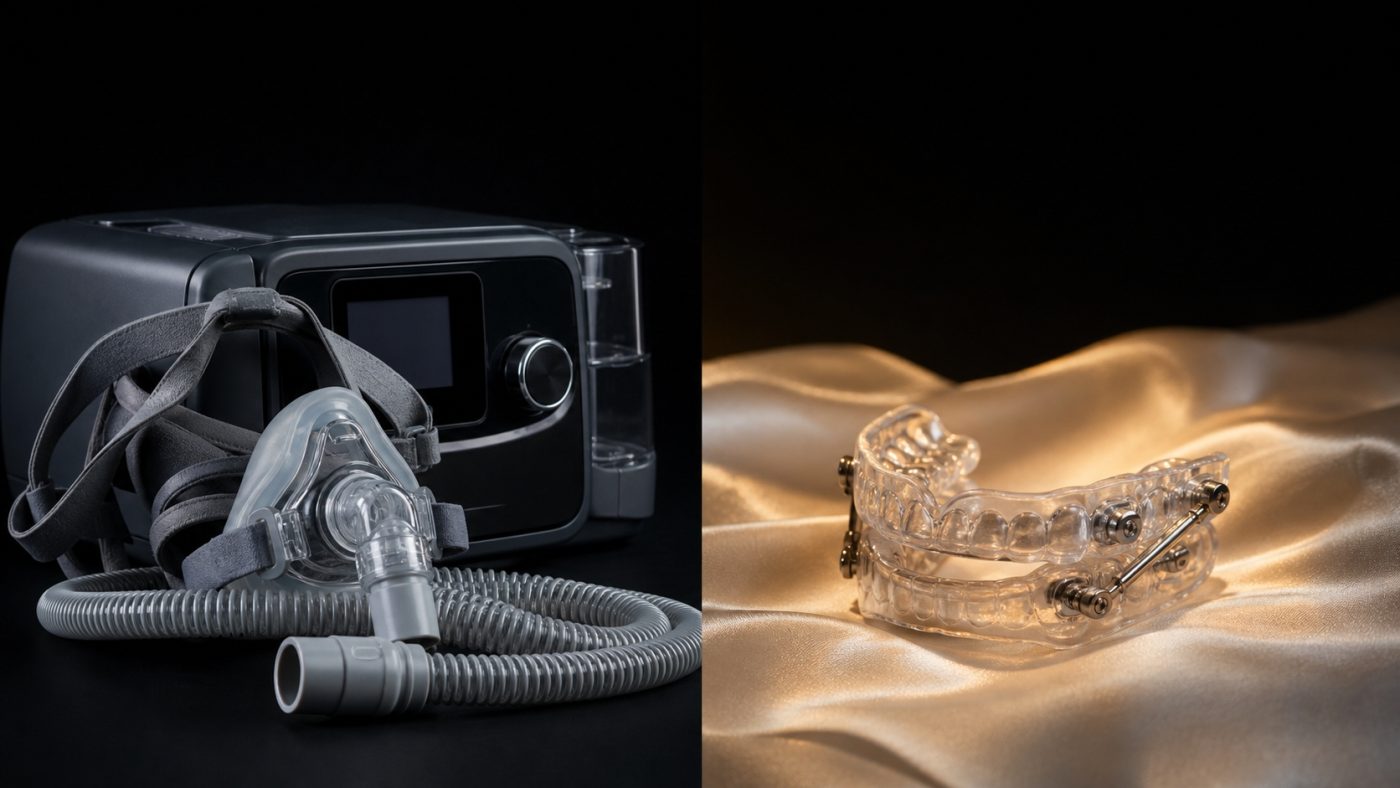
CPAP creates pneumatic splinting of the airway by delivering pressurized air through a mask. The pressure helps prevent the airway from collapsing while the patient sleeps. An oral appliance works mechanically by repositioning the lower jaw and associated soft tissues in a way that can help improve upper-airway space in suitable patients.
For a general explanation of the dental device itself, mandibular advancement splint on Wikipedia provides useful background terminology. It should be treated as general context, not a replacement for clinical guidance.
Why CPAP is often recommended
CPAP is widely used because it can be highly effective at reducing obstructive breathing events when it is correctly prescribed and consistently used. It does not rely on moving the jaw or teeth, and the pressure can be adjusted to match the patient’s airway requirements.
The main limitation is that effectiveness in real life depends on use. Some patients adapt very well to CPAP, while others struggle with mask fit, pressure tolerance, dryness, noise, travel, claustrophobia or simply the practical burden of using a machine every night. These problems do not mean CPAP is a poor treatment; they mean adherence and comfort are important parts of the treatment discussion.
Dubai residents who need medical sleep assessment can access specialist services such as Dubai Health’s Sleep Medicine program, which evaluates and manages conditions including sleep apnea. A sleep physician or other appropriately qualified clinician can help determine diagnosis, severity and the most suitable medical treatment pathway.
When might an oral appliance be considered?
A custom oral appliance can be an evidence-based treatment option for selected adults with obstructive sleep apnea and may also be used for primary snoring when sleep apnea has been appropriately excluded. It is particularly relevant when a patient cannot tolerate CPAP, prefers an alternative and the clinical situation allows it, or when the treating sleep clinician includes oral appliance therapy within the care plan.
The device should not be confused with an off-the-shelf anti-snoring mouthguard. Professional oral appliance therapy requires a dental examination, a custom device, gradual calibration where appropriate, review of symptoms and side effects, and ongoing monitoring of the teeth, bite and jaw.
The 2025 AADSM standards for oral appliance therapy outline clinical expectations for screening, comprehensive examination, appliance selection, calibration, side-effect management and long-term follow-up. These standards reinforce that oral appliance therapy is a managed healthcare intervention rather than a consumer accessory.
What does Dr. Sara Amini assess before oral appliance therapy?
A dental sleep medicine consultation focuses on whether the mouth and jaw can safely support the proposed therapy and whether there are dental factors that could make treatment less predictable.
A dental assessment may include:
- The condition of the teeth and gums
- Existing crowns, bridges, implants and restorations
- Tooth mobility and periodontal support
- How the upper and lower teeth meet
- Jaw-joint movement, pain or clicking
- Jaw-muscle tenderness and range of movement
- Tooth wear or evidence of clenching and grinding
- Tongue, palate and oral anatomy
- Available space for an appliance
- Existing retainers, night guards or previous sleep appliances
Dr. Sara Amini provides snoring and sleep apnea dental care in Dubai from Dubai Healthcare City. Her UAE website states that she has completed the American Academy of Dental Sleep Medicine Mastery Program and is a Diplomate of the American Board of Dental Sleep Medicine as well as an International Certificant.
You can review Dr. Sara Amini’s Dubai biography for more detail on her dental sleep medicine training and clinical background.
CPAP vs. oral appliance: the practical differences
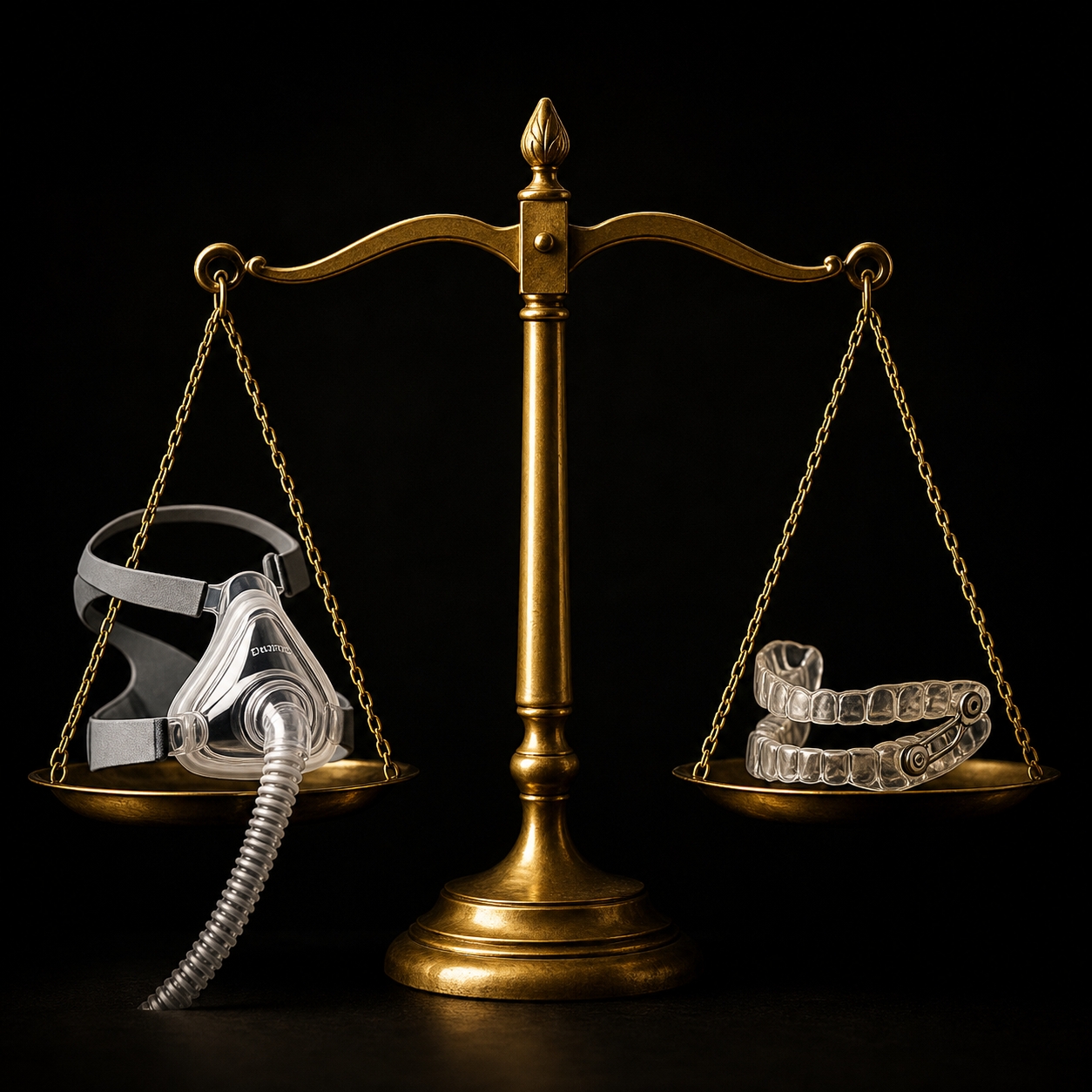
Patients often want a simple winner, but the comparison is more useful when broken into practical categories.
1. Treatment mechanism
CPAP uses air pressure to prevent upper-airway collapse. A mandibular advancement appliance changes lower-jaw position to influence airway anatomy. Because the mechanisms are different, the treatment response can differ substantially from one patient to another.
2. Effectiveness
Positive airway pressure is highly effective at controlling obstructive respiratory events when used correctly. Oral appliances can also be effective in appropriate patients, but response varies with anatomy, severity, device design, mandibular position and individual physiology. This is one reason follow-up testing matters.
3. Comfort and adherence
Some patients prefer CPAP and find it easy to use every night. Others struggle with the mask or machine and find a custom oral appliance more manageable. Conversely, not every patient finds mandibular advancement comfortable. Jaw soreness, tooth tenderness, dry mouth, salivation or bite changes can occur.
4. Travel and lifestyle
An oral appliance is small, does not require mains power during use and is easy to pack. This can be attractive for people in Dubai who travel frequently for work or leisure. Modern CPAP equipment can also be portable, but it remains a machine-based therapy and usually involves a mask, tubing and power supply.
5. Dental requirements
CPAP does not require the teeth to support a device. Oral appliance therapy depends on dental and periodontal stability and may be affected by missing teeth, mobile teeth, active gum disease, extensive restorative work, jaw problems or a bite that is vulnerable to change.
6. Monitoring
Both treatments require follow-up. CPAP may be reviewed using symptoms, device data and medical follow-up. Oral appliance therapy requires dental monitoring as well as appropriate assessment of treatment effectiveness, which may include repeat sleep testing.
Why “I snore less” is not enough to prove treatment success
One of the most important points in comparing CPAP with oral appliance therapy is that symptom improvement is not the same as objective disease control. A patient may snore less and feel somewhat better while still having clinically important breathing events.
For this reason, the treatment plan should include a way to assess whether the therapy is actually controlling sleep-disordered breathing. The sleep clinician may recommend follow-up objective testing after the oral appliance has been adjusted to a therapeutic position.
Can you switch from CPAP to an oral appliance?
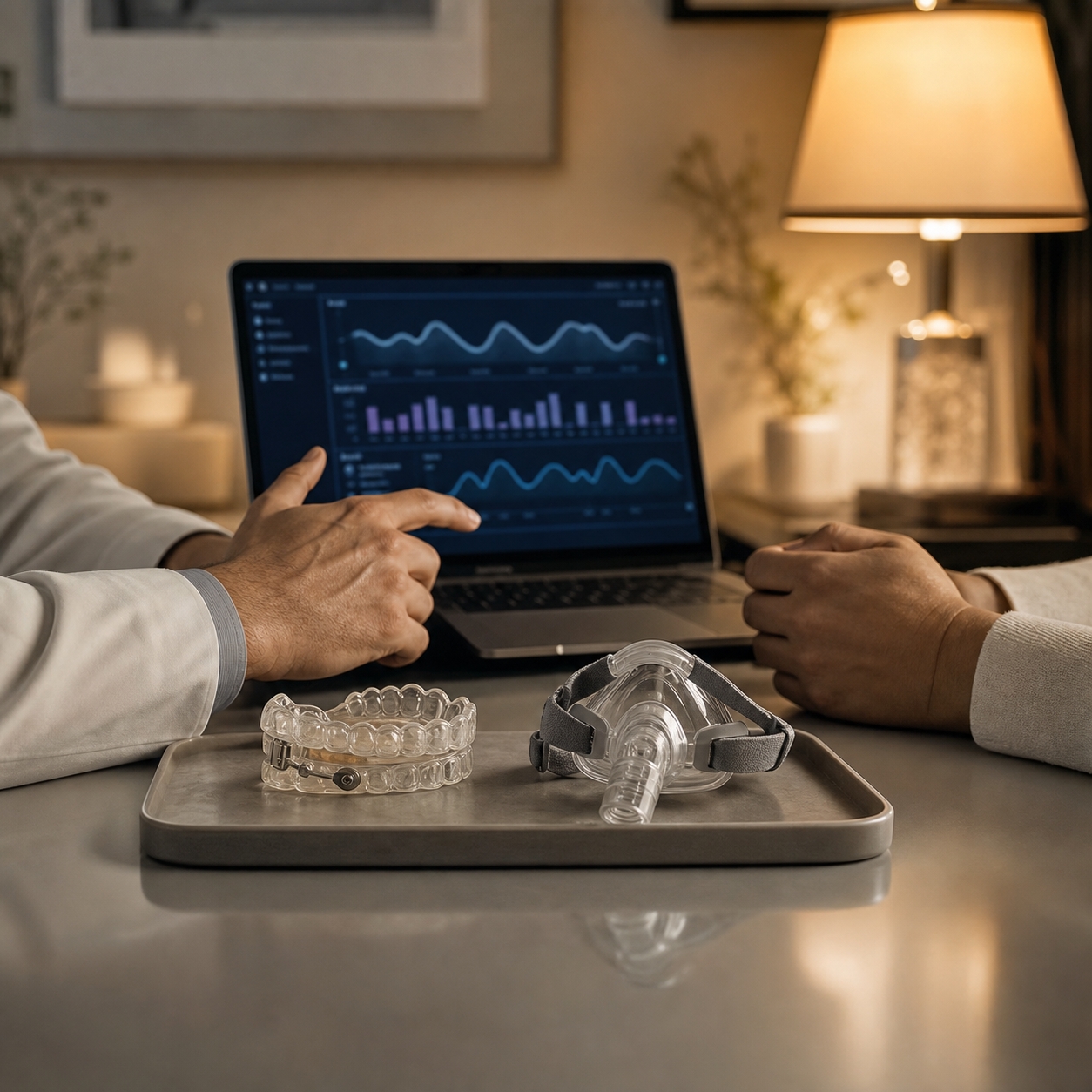
Some patients can transition to oral appliance therapy, but that decision should not be made simply because CPAP is inconvenient. The clinician managing the sleep disorder needs to consider diagnosis, severity, symptoms, oxygenation, medical history and other risk factors. The dentist must separately determine whether the teeth, gums, bite and jaw are suitable for appliance therapy.
If you are currently using prescribed CPAP, do not simply discontinue it before discussing alternatives with the appropriate treating clinician. A safer process is to define the reason CPAP is difficult, determine whether those problems can be corrected, assess whether oral appliance therapy is suitable, and then verify the result if a change is made.
Can both treatments ever be used together?
In selected situations, treatment does not have to be an either/or choice. Some patients may use different therapies in different circumstances, and combination approaches may occasionally be considered by the clinicians involved. For example, a patient who finds full CPAP pressure difficult may discuss whether other strategies can improve tolerance, while a frequent traveler may want to understand what alternatives are clinically acceptable when away from home.
Any combined or alternative approach should be coordinated with the treating sleep clinician rather than improvised by the patient.
Potential side effects of oral appliance therapy
A mandibular advancement appliance changes the position of the lower jaw for several hours every night. That can create short-term adaptation symptoms and, in some patients, longer-term dental changes.
- Temporary jaw or muscle soreness
- Tooth tenderness
- Increased saliva or dry mouth
- Pressure on individual teeth
- Changes in how the bite feels in the morning
- Gradual tooth movement or longer-term bite changes
- Jaw-joint symptoms
- Appliance wear, breakage or the need for replacement
These risks do not mean oral appliance therapy should be avoided; they explain why trained dental oversight and regular follow-up are necessary.
What changes when choosing care in Dubai?
Dubai’s population includes many frequent travelers and people whose healthcare may be shared across more than one country. That makes continuity and documentation especially important. Ask who is responsible for the sleep diagnosis, who reviews treatment effectiveness, who manages the appliance, and how records are shared between the dental and medical teams.
Also ask how many dental visits are likely during fitting and calibration, what happens if you travel for several weeks, how urgent appliance problems are handled, and what long-term review is expected.
Dr. Amini’s practice is located in Dubai Healthcare City, and her contact page provides current clinic and appointment information.
A real-world community perspective – useful, but not medical evidence
Online communities are useful for understanding the practical questions patients have about CPAP masks, dryness, travel, oral-appliance comfort, jaw soreness and whether they actually use the device every night. They are not reliable for deciding which treatment is right for an individual.
For an example of patient discussion, see the Reddit thread “Dental Devices for Apnea”. It should be treated as anecdotal patient context rather than clinical evidence.
For a visual explanation of oral appliance therapy, see the AADSM oral appliance therapy video.
How to prepare for a consultation
Bring your sleep-study report, CPAP prescription or machine data if available, a medication list, relevant medical history and details of any previous oral appliances. Write down the specific problems you are having with CPAP rather than simply saying you dislike it. Mask leakage, pressure intolerance, nasal symptoms, dryness, claustrophobia and travel inconvenience may lead to different discussions.
Questions worth asking include:
- What is the severity and pattern of my sleep apnea?
- Why was CPAP recommended for me?
- Am I medically and dentally suitable for oral appliance therapy?
- What makes a custom titratable appliance different from a generic anti-snoring device?
- What dental or jaw side effects are most relevant in my case?
- How will the appliance be adjusted?
- How often will my bite and jaw be reviewed?
- How will we objectively confirm that the treatment is working?
- If the appliance is not effective enough, what is the next step?
How to recognize an evidence-led treatment plan
A strong treatment plan should explain the diagnosis first, compare realistic options and connect the recommendation to your own medical and dental findings. It should also describe limitations, side effects, the expected follow-up schedule and the method that will be used to judge treatment success.
Be cautious of any message that presents an oral appliance as automatically superior because it is smaller, or CPAP as automatically unacceptable because some patients dislike it. The clinically appropriate treatment is the one that controls the disorder, can be used consistently and can be monitored safely.
Frequently asked questions
Is an oral appliance better than CPAP?
Not universally. CPAP is highly effective for many patients, while a custom oral appliance may be appropriate for selected adults who prefer an alternative or cannot tolerate CPAP. The choice should be based on diagnosis, severity, individual risk factors and clinical assessment.
Can a dentist decide that I no longer need CPAP?
A dentist can assess dental suitability for oral appliance therapy and manage the device, but changes to medical sleep treatment should be coordinated with the clinician responsible for the sleep-apnea diagnosis and management.
Is an oral appliance the same as a night guard?
No. A night guard is generally used to protect teeth from grinding or redistribute bite forces. A mandibular advancement appliance is designed to hold the lower jaw forward during sleep to help maintain the airway in selected patients.
Does an oral appliance work for severe sleep apnea?
Severity is only one part of the decision, and suitability cannot be determined from a website or symptom list. Patients with more significant disease require especially careful medical assessment, and treatment selection should be coordinated with the sleep clinician.
How do you know if an oral appliance is working?
Reduced snoring or improved daytime energy can be encouraging, but objective follow-up testing may be needed to confirm that breathing events are adequately controlled. Dental reviews are also required to monitor comfort, jaw function and bite.
Can I travel with an oral appliance?
Yes, one practical advantage is that a custom oral appliance is compact and does not require electricity during use. However, portability does not determine whether the appliance is clinically suitable or effective for your particular sleep apnea.
What if I cannot tolerate either CPAP or an oral appliance?
Sleep-apnea management can include other approaches depending on diagnosis, anatomy and medical factors, including positional strategies, weight management where relevant, management of nasal or airway issues, and selected surgical or other specialist treatments. Your sleep clinician can discuss which alternatives are appropriate.
Next step
If you have diagnosed obstructive sleep apnea and are comparing CPAP with oral appliance therapy, the most useful next step is a discussion that combines your sleep-study findings with a proper dental assessment. That allows the decision to be based on your diagnosis, oral health, jaw function, treatment preferences and the likelihood that you can use the chosen therapy consistently.
To discuss the dental aspects of sleep-apnea treatment, book a consultation with Dr. Sara Amini in Dubai. You can also review her dedicated Snoring and Sleep Apnea Dubai page before your visit.
